
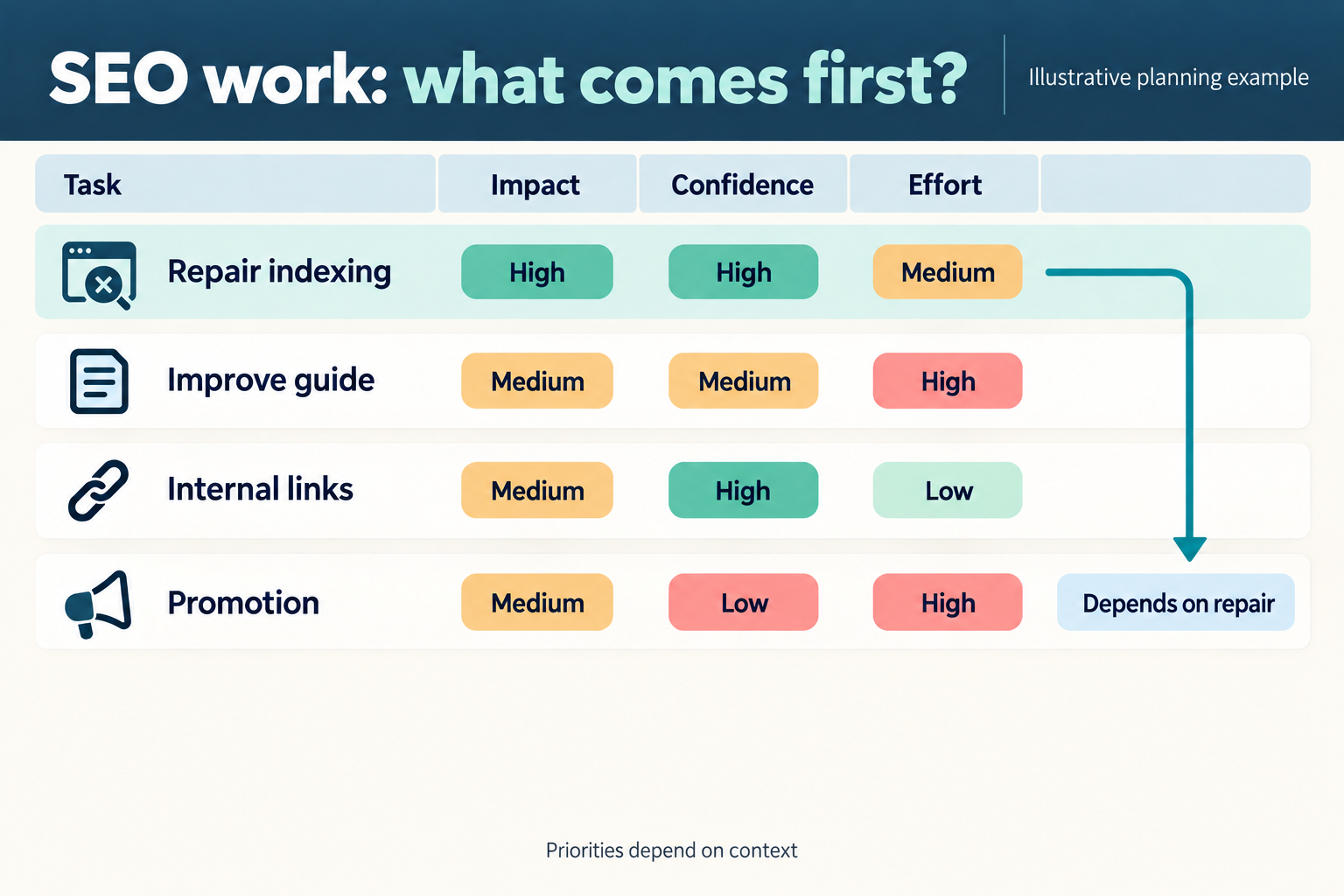
An audit can produce hundreds of warnings without identifying the next useful action. A missing description, an inaccessible product category and an outdated buying guide might appear in the same export. They do not represent the same problem, carry the same evidence or deserve the same deadline.
SEO prioritization starts with an outcome and a constraint: which audience should reach which useful pages, and what is preventing that today? The framework below is an editorial decision method, not a ranking formula or a report of an experiment we performed.
Separate blockers from opportunities
First determine whether important pages can participate in search at all. A production template that accidentally carries a noindex directive is a different class of problem from a title that could be clearer. Confirm the issue on representative URLs and establish its scope before calling it a sitewide emergency.
Use the search diagnostic stages to distinguish discovery, access, indexing and relevance. An indexing problem on retired pages may be intentional. The same behavior on the only pages serving a valuable reader need may deserve immediate attention.
Write an outcome before assigning a score
A useful task states the affected pages, the observed problem, the proposed change and the measurement that could show improvement. “Fix technical debt” is too broad. “Restore crawlable links to the current research archive and check discovery of the affected URLs” is testable.
| Dimension | Question to answer | Evidence to record |
|---|---|---|
| Impact | What reader or business outcome could improve? | Relevant page group, current demand and consequence of failure |
| Confidence | How well does the evidence support this diagnosis? | Reproduced defect, documentation, observation or hypothesis |
| Effort | What will implementation and verification actually require? | Engineering, editorial review, testing and maintenance |
| Dependencies | What must be true before this work can help? | Access, templates, data, approvals or upstream repairs |
Use broad ranges rather than invented precision. “Likely to affect all current category pages” is more defensible than promising a traffic percentage without a model. Confidence should fall when the diagnosis depends only on a vendor warning or one ranking snapshot.
Sequence work around dependencies
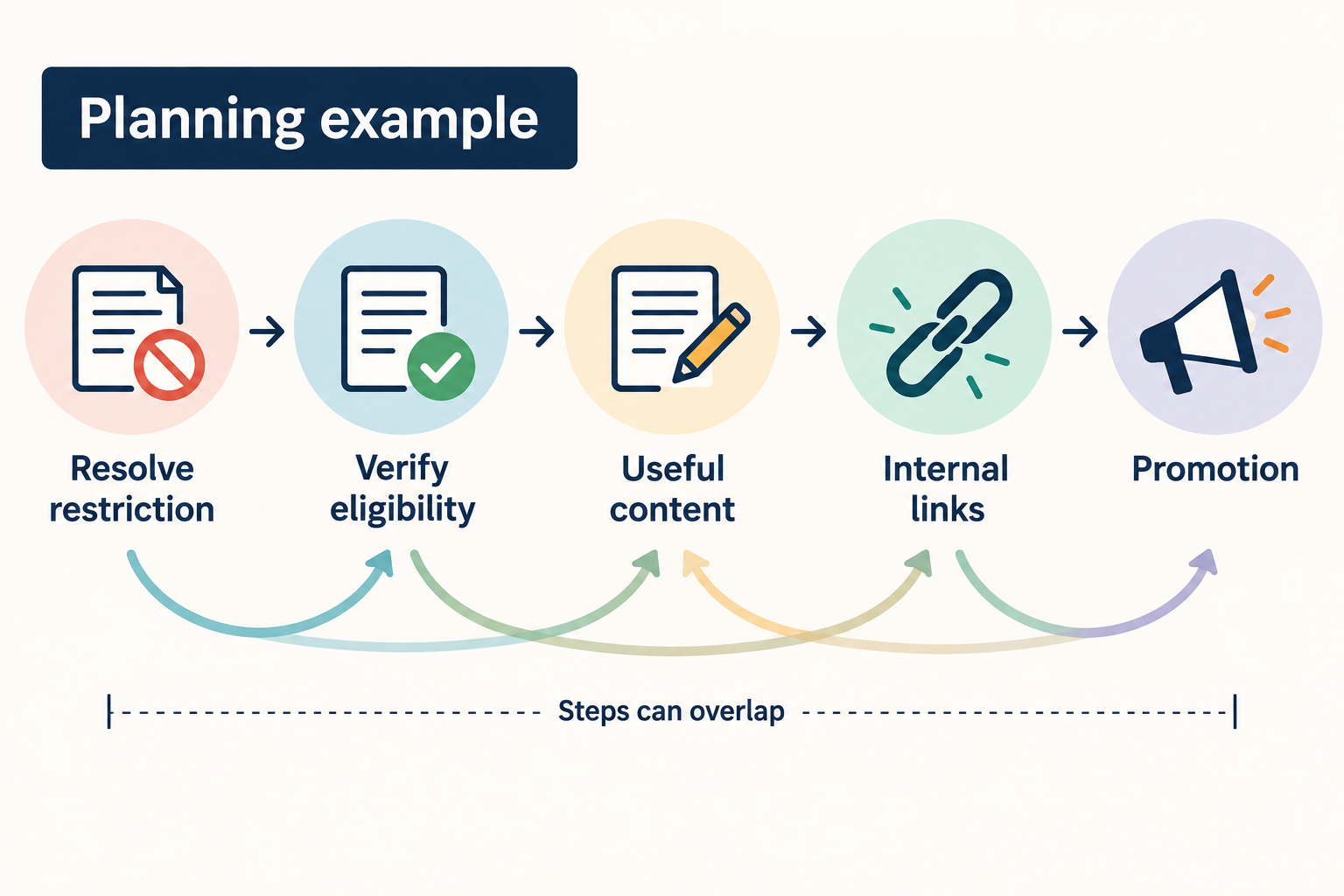
Imagine a guide with no internal links and an unintended indexing restriction. Commissioning promotion before resolving the restriction creates avoidable uncertainty. Correct the confirmed restriction, verify the response, make the guide discoverable and then evaluate whether its content meets the audience need. Promotion can follow once there is a useful, accessible destination.
This is a planning sequence, not a claim that search engines run every URL through a rigid queue. Internal linking may be part of the first repair, and editorial improvements can proceed in parallel. The point is to identify prerequisites instead of treating every task as independent.
Compare different kinds of work fairly
Technical debt earns priority when it creates recurring failures, slows safe publishing or affects a significant page group. A content opportunity earns priority when there is evidence of an unmet need and the publication can contribute something useful. Neither category automatically wins.
Internal links can help readers find a relevant next step and make pages easier to discover. They should be added where the relationship is real. Backlink work needs a credible reason another publisher would reference the material; a higher proprietary authority score is not, by itself, a business outcome.
Consider value beyond raw visits. A small audience reaching a detailed troubleshooting resource may be more useful than a broad audience landing on a page that cannot solve its problem. Define the intended action honestly, whether that is completing a task, finding a source or reaching a relevant product page on a commercial site.
Use a short decision record
- State the problem and affected URLs.
- Label the evidence: documented rule, direct observation, estimate or hypothesis.
- Identify prerequisites and the smallest useful change.
- Set a review window and a success measure.
- Record what would cause you to stop, reverse or expand the work.
For example, a confirmed access defect can justify action before a speculative rewrite. A high-effort migration with uncertain benefit may need investigation first. Low-effort work is not automatically worthwhile: a thousand harmless warning fixes still consume review time.
Review the result without inventing causation
Measure the mechanism you changed before claiming a traffic effect. If you repaired links, verify that the links render and lead to the intended URLs. Then monitor the relevant search measures, with the limitations described in SEO Metrics Explained. A coincident increase in visits does not isolate your change from demand, competition or other releases.
Keep a small active queue and revisit assumptions when new evidence arrives. The research methods hub explains how to design comparisons that make the next prioritization decision less speculative.