
“Running shoes,” “running shoe size calculator” and “running shoes versus trail shoes” share vocabulary. They do not necessarily ask a website to do the same job. Choosing a page type from keywords alone can produce an excellent article for a reader who wanted a catalog, or a product page for someone who needed help comparing options.
Search intent is an interpretation of a task. Search results provide evidence about that interpretation, but they are neither a permanent specification nor a complete account of every user’s needs.
Start with the action the visitor wants to complete
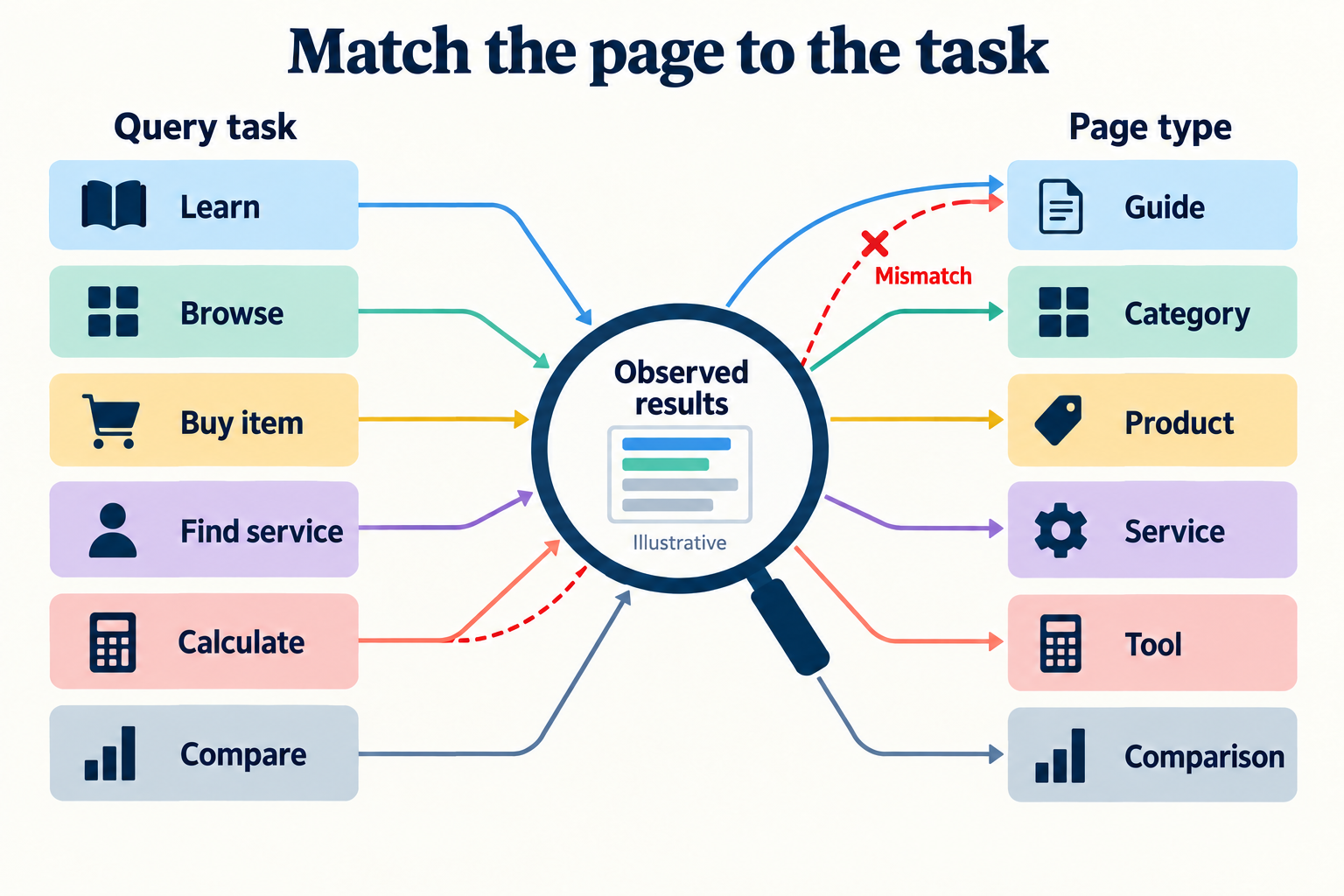
Informational searches seek an explanation or instruction. Commercial investigation involves evaluating alternatives. Transactional searches aim toward an action such as purchasing or booking. Navigational searches try to reach a particular brand, site or destination. These labels are useful shorthand, but a single search can combine several needs.
| Likely task | Candidate page type | What the page must enable |
|---|---|---|
| Understand a process | Guide | A usable explanation with steps and limits |
| Browse a selection | Category | Meaningful options, filters and routes to details |
| Evaluate a specific item | Product | Specifications, availability and relevant decision information |
| Assess a service | Service | Scope, suitability and a clear next action |
| Choose between alternatives | Comparison | Explicit criteria, differences and tradeoffs |
| Calculate or inspect something | Tool | A working input-to-output task with explained assumptions |
These are candidate matches, not a prescription for this publication to sell services. Search Method Journal uses them to analyze website architecture. A navigational query may simply need a reliable route to the requested destination.
Observe the results before committing to a format
Record the query, date, country, language and device. Review a sample of visible results and classify what they let a user do. Look beyond title wording: a “best” page might be a tested comparison, a retailer category or a thin list. Those formats imply different reader experiences.
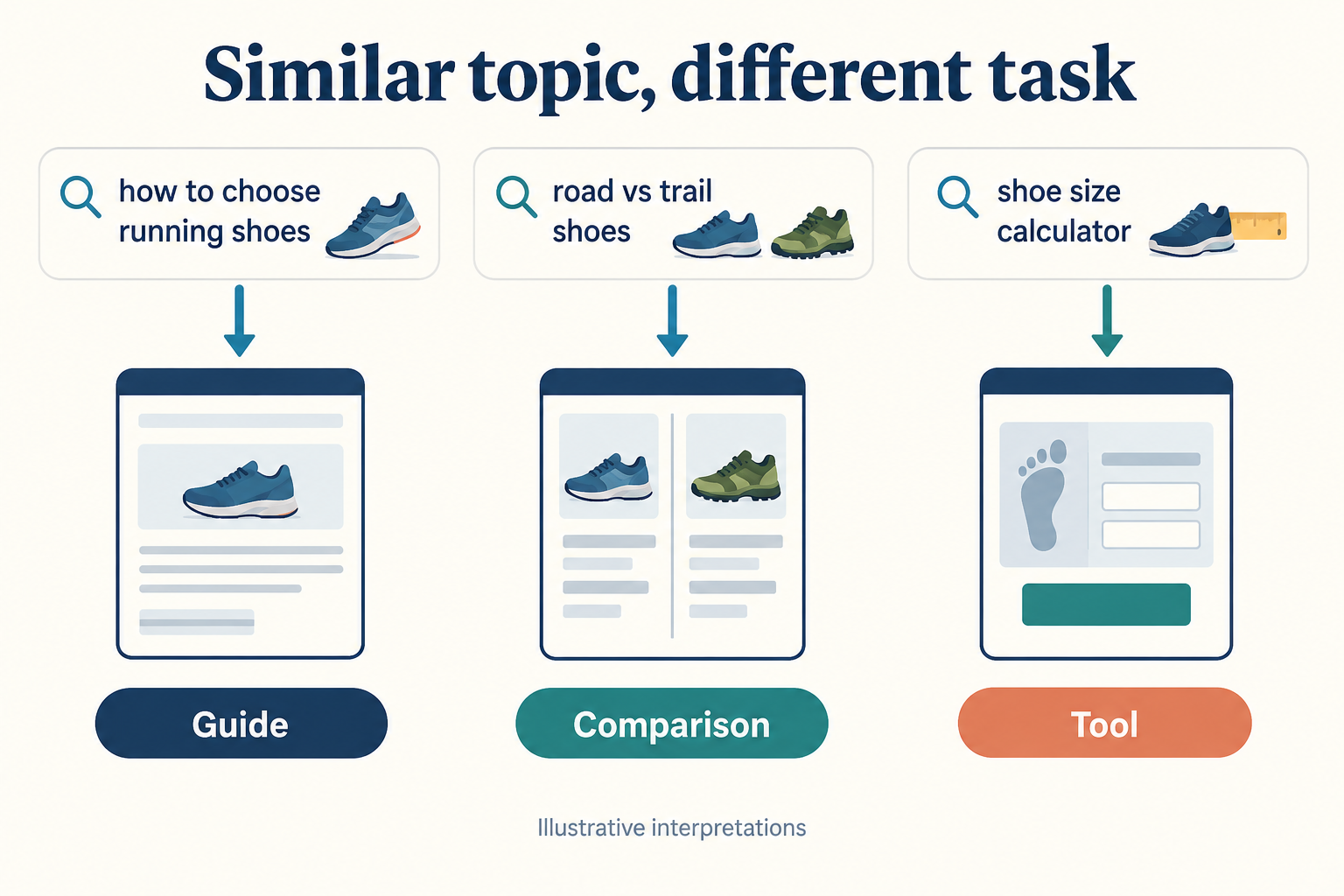
Three shoe-related queries illustrate the method. “How to choose running shoes” suggests a guide; “compare road and trail shoes” suggests a comparison; “running shoe size calculator” suggests a tool. These are illustrative interpretations, not a report of current rankings. Validate the actual results and audience context before choosing a production page.
Mixed results call for a deliberate choice
A results page containing guides, stores and discussions can reflect ambiguity or several valid tasks. Do not average those formats into one unfocused page. Choose the audience and job you can serve well, then provide contextual routes to adjacent needs.
A category can link to a sizing guide without turning into a long essay. A comparison can link to product details without hiding the analysis behind a sales pitch. A guide can link to a useful calculator when a reader needs to apply the explanation.
Diagnose mismatch with behavior, not a label
If a page attracts the wrong queries or cannot support the expected action, inspect both the page and the query group. Search Console can help reveal the searches associated with exposure, but incomplete query data and changing result layouts limit what you can infer from one export.
Look for concrete friction: a calculator query reaching a page with no calculator; a comparison query landing on a catalog without comparison criteria; a navigational search reaching an unrelated article. A weak conversion rate alone does not prove intent mismatch because tracking, usability and traffic composition can also explain it.
Give overlapping pages distinct responsibilities
Two pages using similar keywords are not automatically cannibalizing each other. The concern is whether they compete for essentially the same task without a useful distinction. Compare their purpose, content, internal links and query patterns before consolidating anything.
Write one sentence describing each page’s responsibility. If both sentences are identical, investigate whether one stronger destination would serve readers better. If one page teaches selection and the other lists available items, preserve that distinction and link between them where readers need the transition. Redirect decisions require their own review.
Keep the mapping revisable
Store the evidence alongside the decision: observed formats, competing interpretations, chosen page type and what would cause a reassessment. Recheck when the product, audience or results change. This is more useful than treating intent as a permanent keyword attribute.
The research methods hub explains how to document an observation without turning it into a causal claim. The SEO glossary defines search intent, internal links and content cannibalization.