
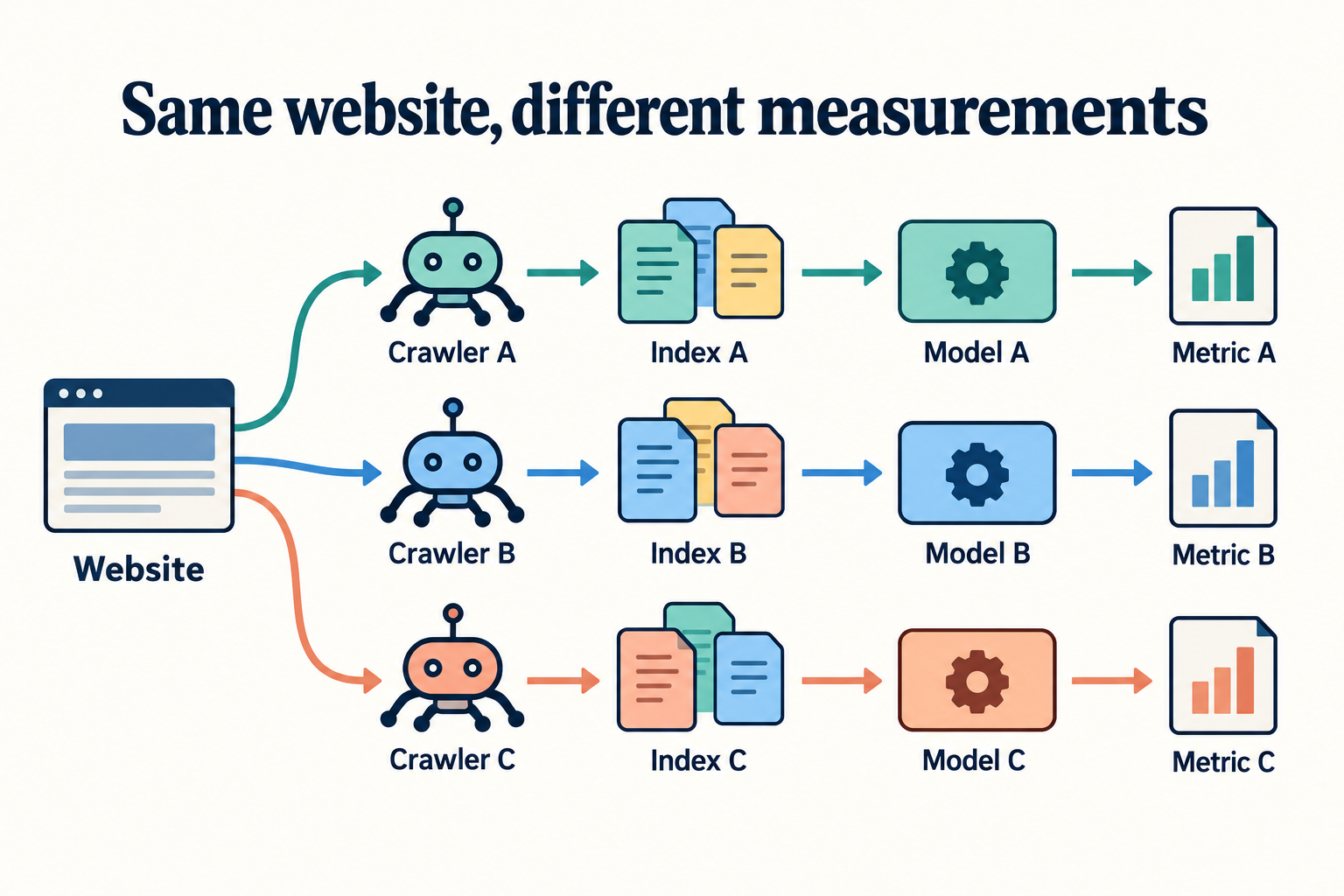
One backlink tool reports a strong domain, another finds fewer referring sites and a third shows links the others omit. That disagreement does not necessarily mean a tool is broken. Each service observes part of the web, maintains its own index and applies its own definitions.
A metric is the output of that system. Before interpreting the number, ask what was observed, when it was observed and what the provider decided to count.
Different crawlers see different link sets
Crawlers discover URLs through different starting points and paths. Their coverage, scheduling, access and processing decisions differ. A new link can appear in one index before another; a removed page may persist in a historical dataset after it disappears from the live web.
Crawl frequency is not uniform across every page. A frequently revisited source and an obscure archive may have different update delays. Comparing exports from different dates therefore mixes a provider difference with a time difference.
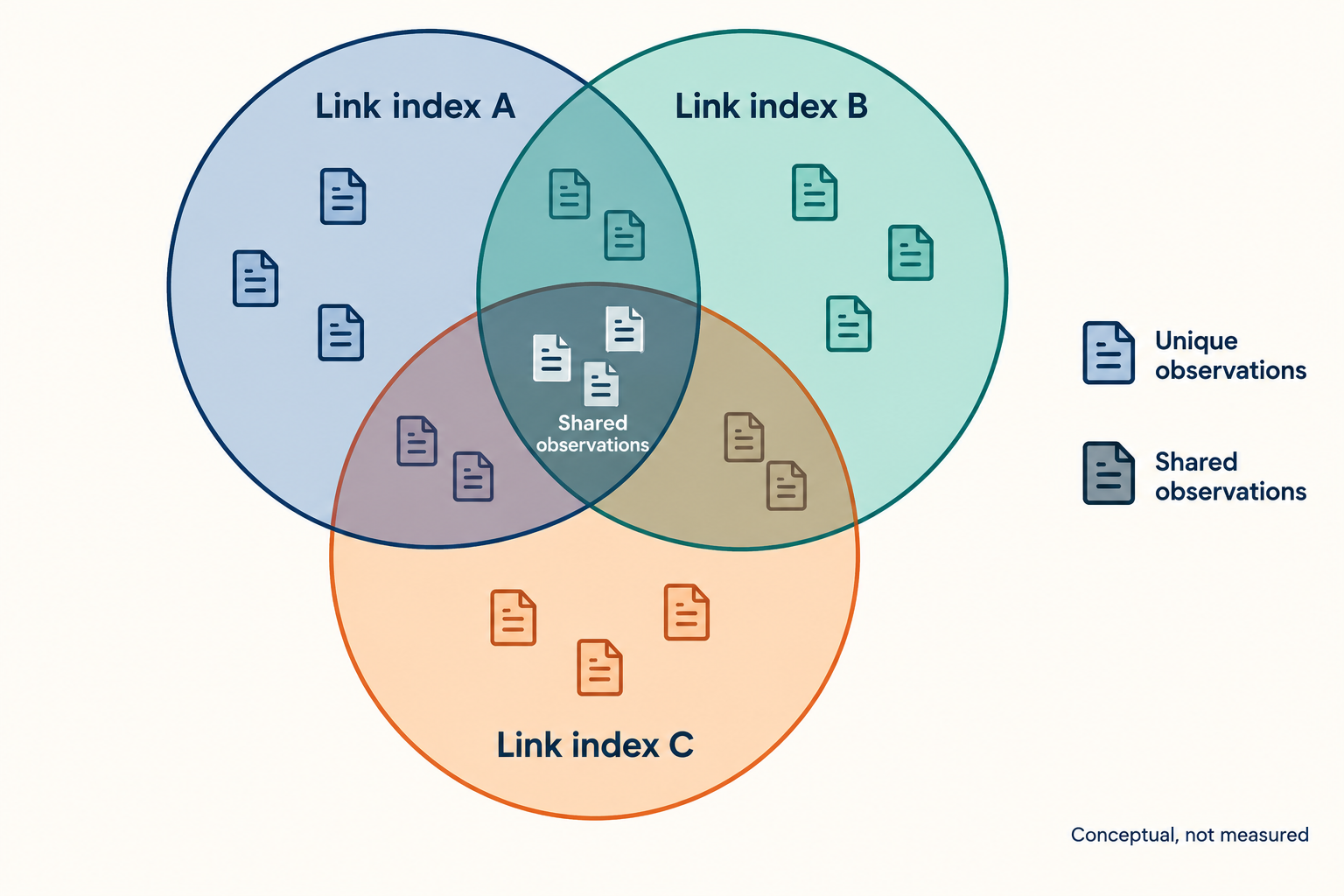
Think of three overlapping sets of observed referring pages. The overlap represents common observations; the unique areas represent observations present in only one dataset. This conceptual picture does not tell you the size or quality of any commercial provider’s index.
Counting rules change the result
A backlink count and a referring-domain count answer different questions. Many links can come from one domain. Sitewide links, duplicate pages and URL variants can expand raw counts without adding equally many independent sources.
Redirects and canonicalization complicate attribution. A tool may associate a link with the requested destination, a redirect target or a consolidated URL according to its own processing. “Lost” may mean a link was no longer found on a recrawl, rather than proving it vanished at a precise moment.
Compare whether the export includes live or historical links, subdomains, redirects and links carrying nofollow or other qualifiers. Read the provider’s current definitions rather than assuming all filters have identical meanings.
Authority scores are proprietary models
Moz’s Domain Authority (DA), Ahrefs’ Domain Rating (DR), and Majestic’s Trust Flow (TF) and Citation Flow (CF) are provider-specific metrics. They are not Google’s ranking metrics. Their names, scales and methodologies should remain attached to the provider when you report them.
A higher value in one system does not establish an equivalent value in another. Even when scores use similar numeric ranges, they need not measure the same construct. A change can reflect newly observed links, a changed comparison population or model updates rather than a change in Google’s assessment.
Use the provider descriptions for Domain Authority, Domain Rating and Majestic’s terminology to interpret the exported field. See SEO Metrics Explained for the distinction between first-party measurement and third-party estimation.
Page-level and domain-level questions differ
A domain-level score describes a modeled property of a broader link profile. It cannot tell you, on its own, whether a particular page is useful, relevant, editorially trustworthy or actually linking to your intended destination.
Inspect the source page. Is the link visible in context? Does it help a reader? What is the anchor text? Does it resolve to the expected page? Is the surrounding material relevant? A strong-looking domain score cannot replace those checks.
Reconcile the exports before judging them
- Align target scope: exact URL, prefix, subdomain or whole domain.
- Record export dates, index type and active filters.
- Normalize URL formatting carefully while preserving meaningful differences.
- Sample disagreements and visit the source pages.
- Record current response, link destination, qualifiers and observed status.
- Report unresolved differences instead of forcing a single “true” count.
This workflow can explain why two reports diverge. It cannot recreate a search engine’s private link graph. Keep raw observations separate from a provider’s score and from your own interpretation.
Use metrics to choose what to inspect
Backlink data is useful for finding references, discovering relevant publications and investigating lost destinations. Use scores as screening signals inside a broader review. Do not turn one score into a purchase rule, a ranking guarantee or proof that a link will help.
If you want to evaluate a link-related change, define the hypothesis and competing explanations first. The research methods framework explains why a ranking movement after a new link does not isolate that link’s effect.