
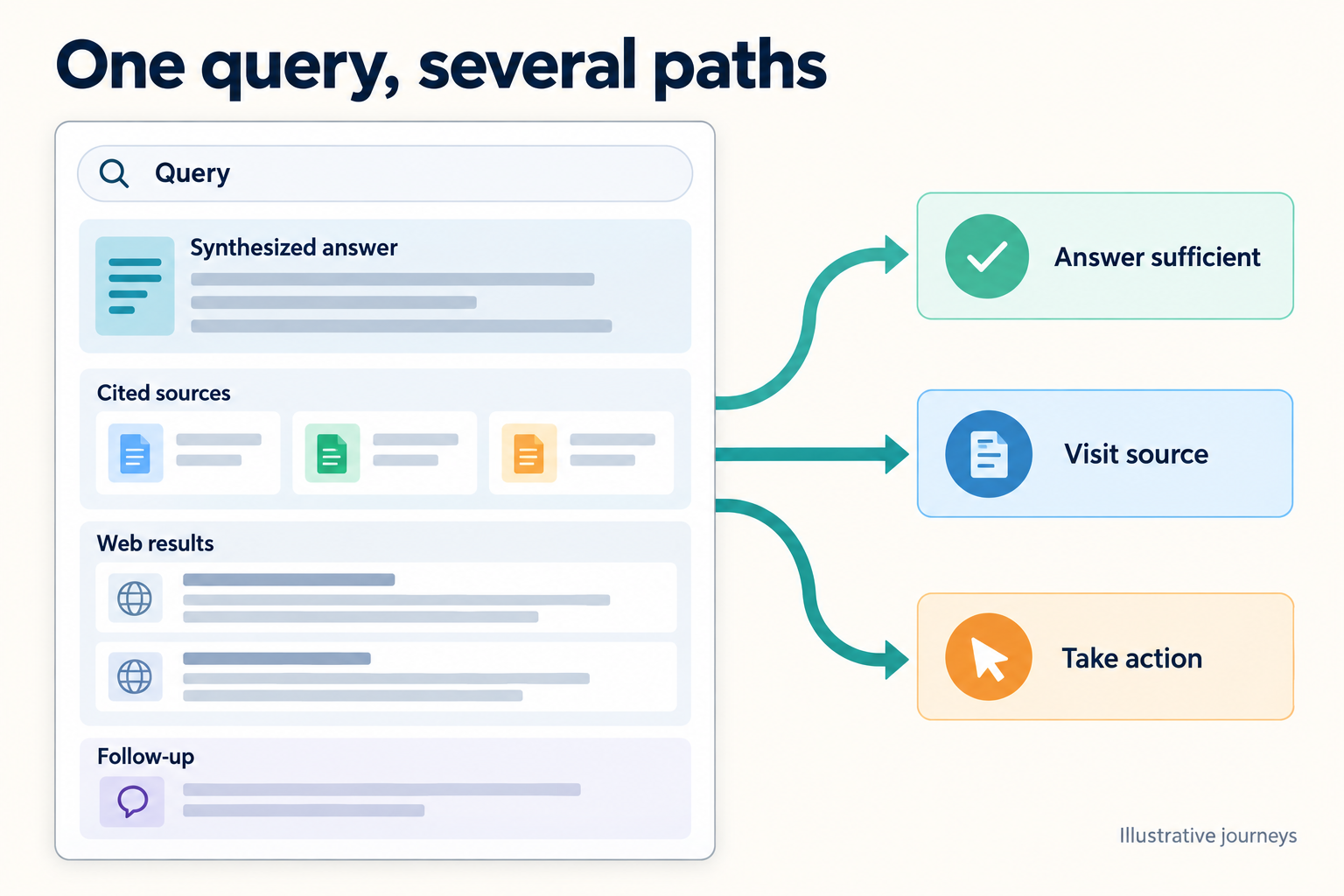
A search interface can provide an answer before someone opens a website. That changes the decision facing a reader: leave with the answer, inspect a supporting source, ask a follow-up or move toward an action. The website is now part of several possible paths rather than the inevitable next screen.
This article distinguishes documented Google behavior from editorial interpretation. It does not claim that all AI search products use the same retrieval systems, reporting or source-selection rules. Platform documentation was checked on October 2, 2026.
An answer can be a destination or a starting point
Google describes AI Overviews and AI Mode as search experiences that can connect answers with supporting web pages. Its documentation discusses retrieving relevant material and, for some responses, issuing related searches through query fan-out. Those descriptions explain capabilities; they do not disclose a formula publishers can reproduce to guarantee citations.
A citation is a route to a source and a cue a reader can investigate. It does not prove that the entire generated answer accurately represents that source. Readers still need to check whether the linked material supports the particular claim and whether its context or limitations were preserved.
Compare journeys rather than assuming all clicks disappear
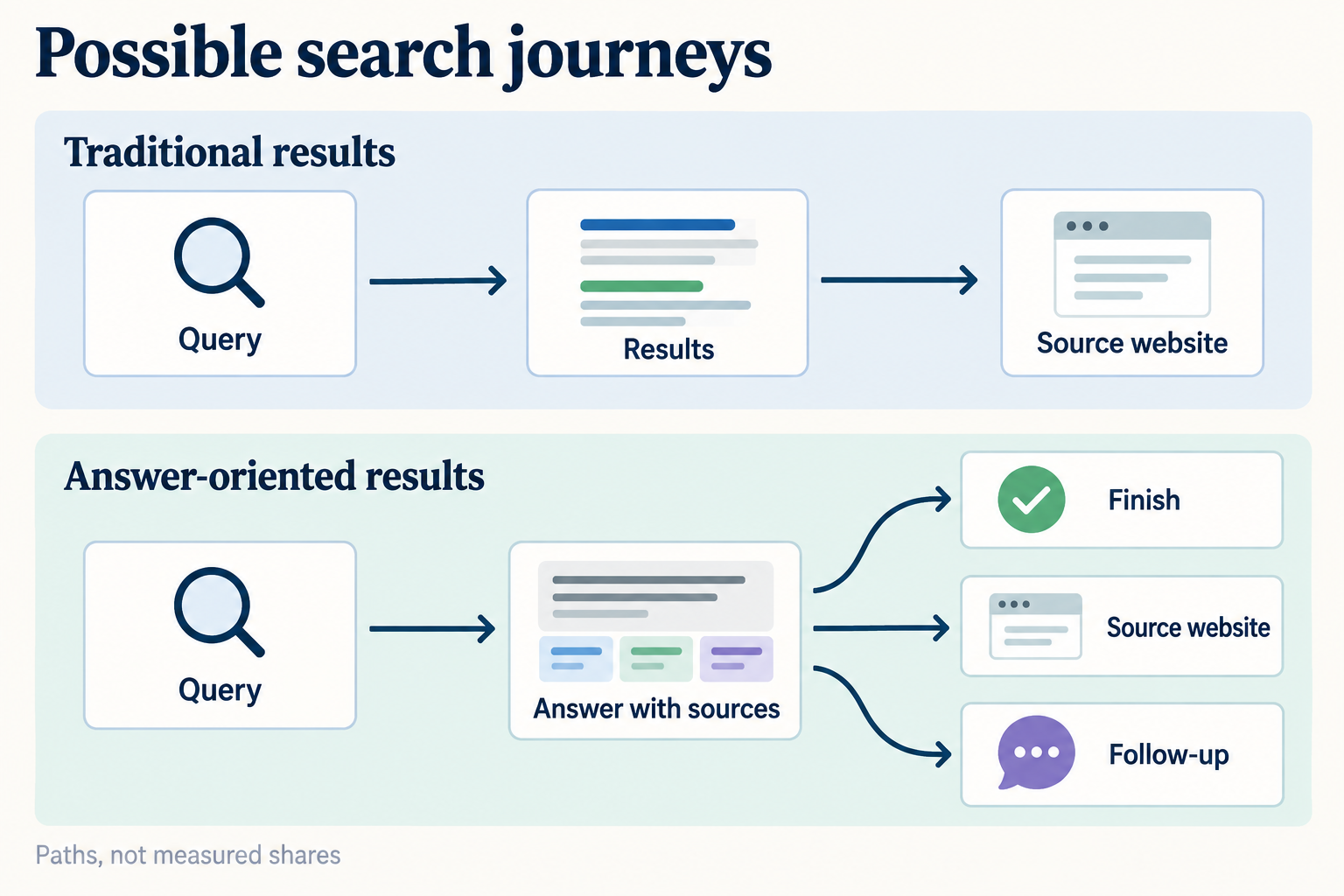
In a conventional results journey, a reader chooses a result and evaluates the destination. In an answer-oriented journey, that evaluation may begin inside the search interface. Someone seeking a short definition may finish there. Someone checking a technical procedure may open a citation. Someone comparing products may continue to a catalog or product page.
These are possible journeys, not measured shares of users. “Zero-click” describes a search that does not lead to a website click under a study’s definition. It does not, by itself, establish satisfaction, lost revenue or the effect of a particular AI feature. Any percentage needs a stated sample, platform and method.
Give a source visit a reason to exist
A source page can offer detail that a short answer cannot conveniently carry: original evidence, a reproducible method, a working tool, a complete comparison or context for an exception. A generic restatement has a weaker reason to earn a deeper visit.
For a practical guide, explain the assumptions and failure cases. For a comparison, show the criteria and what you actually evaluated. For a dataset, describe collection and limits. Do not invent firsthand research to make a page appear distinctive. Useful specificity is more defensible than manufacturing a claim of experience.
Brand discovery may happen before a visit, but exposure and remembered awareness are different measurements. Treat brand effects as a hypothesis unless you have evidence capable of measuring them. Commercial and action-oriented searches also vary: some require details or a transaction beyond an answer, while others may be resolved within an interface.
Technical fundamentals still matter
Google’s current generative AI optimization guide connects these features to Search’s core systems. It says eligibility requires an indexed page that can appear with a snippet, and directs owners to the relevant Search Console inclusion setting. Eligibility is not a guarantee of selection.
The same guide rejects a universal special-markup shortcut. Clear content, accessible pages and useful organization remain sensible priorities. Structured data can support applicable search features, but there is no single special schema that guarantees an AI citation. Other platforms may document different controls; do not transfer Google’s rules to them without checking.
Use headings and tables when they help people understand the material. Preserve coherent explanations instead of chopping every sentence into isolated fragments for a supposed retrieval trick. Diagnose access and indexing through the search diagnostics framework before speculating about hidden selection factors.
Measure what the report actually measures
Google’s current guide points to a Generative AI performance report in Search Console. Check the report’s definitions, availability and supported metrics directly before combining it with other search data. Do not assume an exposure, a citation and a click are interchangeable, or that an analytics referral identifies every prior AI interaction.
For a repeatable observation log, record the query, date, locale, interface, source links and whether a response appeared. Repeated observations can describe variability; they cannot reveal a confidential ranking mechanism. Connect that log to actual visits and useful outcomes only where the available data supports the connection.
The durable editorial question is what a reader gains by opening the source. The research methods hub provides a way to test specific hypotheses, and our editorial standards explain how we separate documented behavior from interpretation.